

© 2025 Landeye.com | All Rights Reserved
© 2025 Landeye.com | All Rights Reserved
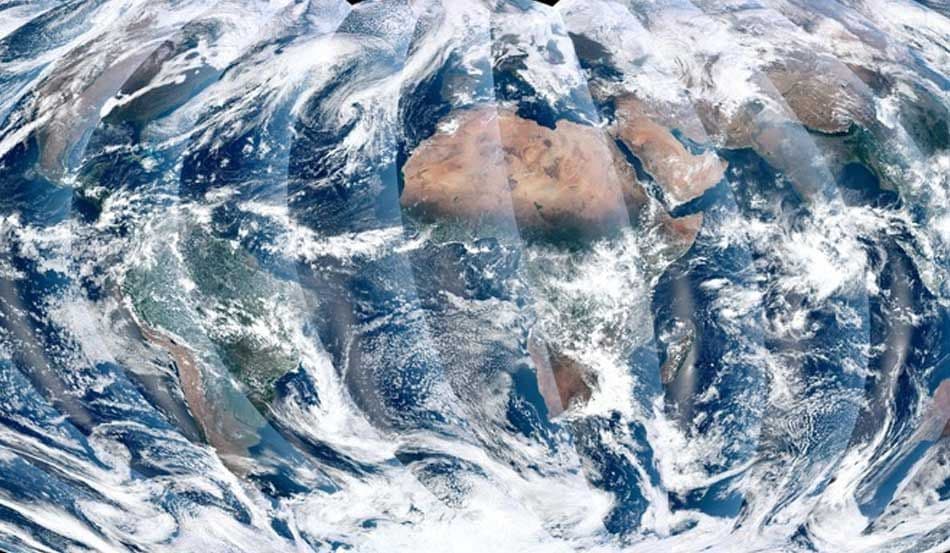
For decades, satellite imagery has been synonymous with observation. Governments, researchers, and analysts have relied on Earth observation data to understand what is happening on the planet—mapping land cover, tracking environmental change, and documenting events after they occur.
However, as we enter 2026, the satellite imagery market is undergoing a fundamental shift. The value of Earth observation is no longer defined by the ability to see the Earth, but by the ability to use that information in real-world operations.
Across industries—from disaster response and insurance to agriculture, infrastructure, and finance—decision-makers are asking a different question than they did before. Instead of asking “What does the imagery show?”, they are asking “How fast can I access the right imagery, and can I use it in time to make a decision?”
This shift marks the emergence of what the market increasingly refers to as Operational Earth Intelligence. Yet, despite growing attention around analytics, AI, and modeling, the most significant bottleneck today is not intelligence itself. It is access.
Operational Earth Intelligence refers to the use of satellite imagery and spatial data as a direct input to operational decision-making, rather than as a static or retrospective source of information.
In this context, imagery is not an end product. It is a component within a broader workflow that supports actions such as:
What defines this operational shift is not the sophistication of algorithms alone, but the timeliness, reliability, and relevance of the data being used.
Operational Earth Intelligence is not about replacing human judgment. It is about ensuring that decision-makers are not operating blindly—or with outdated information—when time, cost, and risk matter most.
To understand why access has become the critical issue, it is important to examine how the Earth observation market has traditionally functioned.
Historically, satellite imagery has been consumed through a fragmented ecosystem:
In this model, imagery was often used for:
While these use cases remain important, they are poorly aligned with operational needs. A disaster response team cannot wait weeks for procurement approvals. An insurer cannot rely on outdated reference imagery. A farmer cannot make irrigation decisions based on last month’s data.
The operational gap is not caused by a lack of satellites. It is caused by friction in discovery, access, and acquisition.
By early 2026, the satellite imagery supply side is stronger than ever:
Yet demand-side frustration continues to grow.
Organizations across sectors consistently face the same challenges:
As a result, operational teams often revert to suboptimal alternatives—ground reports, partial datasets, or delayed decisions—despite knowing that better data exists.
This is where the promise of Operational Earth Intelligence begins to break down.
Before imagery can inform any decision, three conditions must be met:
Without these conditions, advanced analytics and AI models become irrelevant.
In operational contexts, speed is not a convenience—it is a requirement. A dataset that arrives too late has no operational value, regardless of its quality.
This reality is reshaping buyer priorities in the satellite imagery market. Increasingly, organizations evaluate providers not only on resolution or sensor type, but on how easily imagery can be sourced, compared, and acquired.
The transition toward operational use is being driven by tangible needs across multiple sectors.
Emergency agencies require near-real-time situational awareness across large areas. Satellite imagery enables rapid assessment of impacted zones, infrastructure damage, and access constraints.
However, operational value depends on immediate access. If imagery acquisition is delayed, response coordination suffers.
Insurers increasingly rely on satellite data for underwriting, claims verification, and portfolio risk analysis. The effectiveness of these workflows depends on fast access to pre- and post-event imagery.
Delays introduce uncertainty, increase costs, and reduce confidence in outcomes.
Precision agriculture depends on frequent, reliable imagery throughout the growing season. Farmers and agribusinesses need consistent access to multispectral data to monitor crop health, water stress, and yield potential.
Operational decisions cannot wait for complex procurement cycles.
Utilities, mining operators, and infrastructure owners use satellite imagery to monitor assets, detect changes, and assess exposure to environmental risks.
Here again, access speed determines whether imagery supports prevention or merely documentation.
Much of the industry conversation around Earth intelligence focuses on analytics, machine learning, and AI-driven insights. While these capabilities are valuable, they assume that imagery is already available, timely, and fit for purpose.
In practice, many organizations struggle long before analytics enter the picture. The inability to quickly source the right imagery prevents workflows from reaching the analysis stage at all.
This creates a paradox: as analytical capabilities advance, operational outcomes remain constrained by basic access limitations.
The market does not need more intelligence if it cannot reliably reach the data that intelligence depends on.
The Earth observation value chain can be simplified into four layers:
Most innovation attention has focused on layers three and four. Yet layer two—data access—remains underdeveloped relative to its importance.
Without a reliable access layer, the rest of the chain cannot function efficiently.
In this evolving market, platforms that focus on simplifying imagery access play a critical enabling role.
LandEye does not position itself as an analytics provider or a decision engine. Instead, it addresses the most persistent friction point in the Earth observation ecosystem: access.
By offering centralized discovery and procurement of satellite imagery from multiple providers, LandEye enables organizations to:
This approach aligns with how operational Earth intelligence actually begins—not with algorithms, but with timely access to the right data.
In operational environments, decision-makers rarely have the luxury of vendor-by-vendor negotiations or manual sourcing. They need clarity, speed, and reliability.
Marketplaces reduce fragmentation by abstracting complexity. Instead of navigating multiple operator portals, contracts, and formats, users interact with a single access layer.
This model does not replace satellite operators. It amplifies their reach by making their data easier to use in real-world scenarios.
As Earth observation becomes embedded in daily operations, access speed and simplicity become competitive differentiators.
Organizations that can obtain imagery quickly gain:
Those that cannot are left reacting after the fact.
In this sense, access is not merely a technical concern—it is a strategic one.
Looking ahead, several trends are likely to accelerate:
Across all of these trends, access remains the common denominator.
The organizations that succeed will not be those with the most advanced models alone, but those that remove barriers between data and decision-making.
The satellite imagery market is no longer defined by the ability to observe the Earth. It is defined by the ability to act on that observation.
Operational Earth Intelligence does not begin with analytics or AI. It begins with timely, frictionless access to the right imagery.
As industries increasingly rely on Earth observation to manage risk, respond to change, and plan for uncertainty, access becomes the foundation upon which all intelligence is built.
By focusing on simplifying imagery discovery and procurement, platforms like LandEye address the most immediate and practical challenge facing the market today.
In 2026, the question is no longer whether satellite imagery is valuable. The question is whether organizations can access it fast enough to matter.
case studies with similar tags.
Articles with similar tags.
New to LandEye? Visit the Docs to see how tasking, escrow, and provider catalogs work together.
